By Percy Gilbert, SVP Engineering at SkyWater
Summary: Scaling quantum technologies from laboratory demonstrations to reliable, repeatable manufacturing is one of the biggest challenges facing the industry. Quantum manufacturing must be designed with yield, process control, materials, and system integration in mind from the start — building on decades of semiconductor manufacturing expertise while developing new processes for emerging quantum technologies.
Over the past few months, I’ve had the opportunity to share my perspective at industry events (SEMI’s SMC conference in July and, most recently, Quantum World Congress) on an increasingly important question for the future of quantum computing: How are we going to manufacture it?
Both events highlighted the breadth of the quantum ecosystem, from core hardware architectures and technology tutorials to software stacks and go-to-market strategies. But before quantum computing can deliver on its commercial promise at scale, we have to solve the fundamental engineering challenge of manufacturing.
This is a question I believe SkyWater is uniquely positioned to address. We aren’t approaching quantum manufacturing as a theoretical exercise; we are working directly with the materials, processes, and equipment required to build quantum technologies today. What we’re learning is that manufacturing quantum devices requires the exact same engineering fundamentals that have defined successful semiconductor manufacturing for decades:
- Yield & Repeatability: Ensuring every wafer process produces consistent, functioning devices over time.
- Process Control & Variability: Tightly controlling atomic-level material conditions to eliminate errors.
- Reliability & Scalability: Transitioning from small-scale demonstrations into high-volume production environments.
Quantum Manufacturing Builds on Traditional CMOS Foundations
Quantum computing may represent a fundamentally different approach to information processing, but manufacturing quantum devices doesn’t mean throwing out everything we’ve learned about semiconductor manufacturing. The core disciplines of fab execution still apply.
A process has to be repeatable. Materials have to be consistent. Variability has to be strictly controlled. Yield has to improve over time. And ultimately, the technology has to move from small-scale lab demonstrations toward a high-precision production environment.
The challenge is that quantum technologies often require specialized materials and process steps that aren’t part of a conventional semiconductor manufacturing flow. That means we have to solve two problems at once: develop the technology and develop the manufacturing framework to produce it.
Bridging the “Valley of Death”
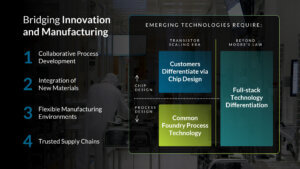
One of the biggest challenges facing emerging tech is the transition from research and development into production. Technology can work beautifully in the lab but face huge obstacles when it’s time to manufacture it reliably and economically. Historically, that transition has involved handing a technology from one organization or environment to another – a handoff that introduces risk, timeline friction, and the potential loss of critical process knowledge.
Development Without the Traditional Handoff
SkyWater’s Technology-as-a-Service (TaaS) model spans the entire technology development continuum – from basic research and proof of concept through lab prototypes, scaled demonstrations, and full manufacturing. Instead of treating development and production as disconnected activities, SkyWater supports technologies seamlessly as they move through those stages.
That matters deeply for quantum. When we’re developing a new material or process, we’re not just asking whether we can make a single device work. We’re thinking about how that process will eventually operate in a high-yield manufacturing environment. The goal is to build the production pathway while we’re building the technology itself.
Traditional foundry manufacturing is built around established, rigid process flows. But emerging quantum technologies don’t always fit neatly into an established box. Quantum customers often need to co-optimize materials, process conditions, device structures, and manufacturing steps simultaneously. Rather than requiring emerging technology to conform to a fixed manufacturing environment, we work with customers to co-develop the manufacturing process itself.
Innovation at the Tool & Material Level
One of the most compelling aspects of quantum manufacturing is that the equipment itself isn’t always new; what is new is how we engineer its use. At SkyWater, we routinely work with equipment and materials suppliers to extend the capabilities of mature semiconductor tools for entirely new applications.
| Application Area | Process Engineering Challenge | SkyWater Precision Solution |
|---|---|---|
| Superconducting Materials | Deposition of NbN & NbTiN requires extreme phase & stoichiometry control. | Implemented external closed-loop controllers using target-voltage feedback for precise reactive gas delivery. |
| Planarization & Surface Roughness | Novel quantum materials lack off-the-shelf polishing recipes. | Co-developed specialized CMP slurries, materials, and process flows to achieve required planarity and uniformity. |
“Bringing tool capabilities and semiconductor engineering together allows us to create manufacturing solutions for technologies that don’t yet have an established playbook. Increasingly, that process integration itself becomes a major source of intellectual property and competitive advantage.”
Quantum Isn’t One Single Technology
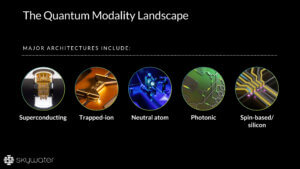
Another important point is that there isn’t just a single path to quantum computing. The broader industry is pursuing multiple hardware modalities, each with distinct technical characteristics and manufacturing requirements:
- Superconducting Architectures: Requires specialized niobium processing, Josephson-junction fabrication, multilayer niobium wiring, and ultra-low-loss dielectrics.
- Photonic Technologies: Demands high-precision silicon-nitride waveguides and optical couplers.
- Trapped-Ion, Neutral-Atom, & Silicon-Based Approaches: Each introduces unique material systems and integration flows.
We’re not betting on a single quantum architecture. We’re building the manufacturing capabilities required to support an evolving, high-performance computing ecosystem.
Quantum Computing Requires Deep System Integration
Ultimately, quantum manufacturing will require much more than a process that produces a good qubit. The quantum systems of the future will need to tightly integrate quantum devices with:
- Control Electronics (e.g., Cryogenic CMOS bringing control logic directly adjacent to qubits).
- Photonics & Interconnects (supporting massive data flow and optical coupling).
- Heterogeneous Integration & Advanced Packaging (engineered for extreme thermal and cryogenic operating environments).
Materials, equipment, processes, control electronics, and packaging cannot be developed in silos and connected at the very end. They must be co-designed to work together from day one.
Manufacturing Is the Bottleneck and the Opportunity
The quantum industry has made remarkable physics progress. The next grand challenge is turning that progress into manufacturable, scalable systems. That work needs to happen now, not after quantum technologies are fully mature.
If we wait until the end of the decade to figure out how to manufacture quantum devices at scale, we will have waited too long. Manufacturing pathways, materials qualification, process control, supplier ecosystems, and integration strategies all take years to refine. The companies and manufacturing partners that solve those engineering problems today will be the ones positioned to lead commercialization tomorrow.
“The future of quantum computing isn’t just being invented in the lab. It is being industrialized in the fab.”
Manufacturing readiness is ultimately what will determine which quantum technologies reach true commercial impact and which remain confined to research labs. As the industry pushes toward larger systems, higher fidelity, and more integrated architectures, the ability to translate promising ideas into manufacturable processes will become the true differentiator.
The quantum era will be defined by those who can build the next generation of compute technologies. And at SkyWater, that work is already underway.